Core Overview
The following block diagram gives an overview of the rvlab_core module.
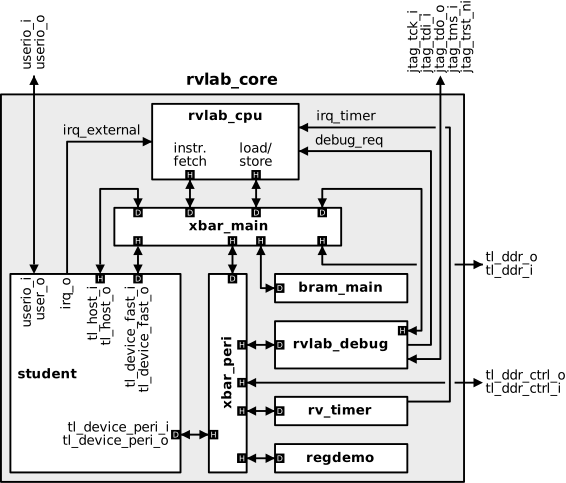
rvlab_core block diagram
H indicates a TL-UL host port, D a TL-UL device port.
The system clock and reset are provided to rvlab_core as clk_i and rst_ni. Please do not use the alternative reset signal rst_dbg_ni outside the rvlab_debug module. Consult Clocks and Resets for details.
Components:
rvlab_cpu – contains the CV32E40P CPU implementing the RV32IMC instruction set
xbar_main – main crossbar switch (fast accesses)
xbar_peri – periphery crossbar switch (slower accesses)
student – module for exercises and project implementation
bram_main – main block RAM for instruction and data storage
rvlab_debug – contains the RISC-V debug module, and JTAG debug transport module, can interrupt CPU using non-maskable debug_req, provides direct system bus access (SBA) to debug host
rvlab_timer – simple timer module, can raise interrupt request irq_timer
regdemo – register generation demo module
The tl_ddr_i/tl_ddr_o and tl_ddr_ctrl_i/tl_ddr_ctrl_o ports connect to a DDR3 memory controller instantiated outside of rvlab_core.
To obtain the most accurate documentation of CV32E40P and OpenTitan for the purposes of the RISC-V Lab, please checkout the commits of CV32E40P and OpenTitan mentioned at Source Projects. The latest online documentation of CV32E40P and OpenTitan may differ substantially from the used versions.
Student module
The student module is equipped with the following inputs / outputs:
tl_device_peri_i/tl_device_peri_o – TL-UL device port connected to xbar_peri
tl_device_fast_i/tl_device_fast_o – TL-UL device port connected to xbar_main
tl_host_i/tl_host_o – TL-UL host port connected to xbar_main
irq_o – interrupt output (level sensitive) connected to irq_external of the CPU
userio_i/userio_o (types userio_board2fpga_t and userio_fpga2board_t) – connects external hardware to student module, see FPGA Board